🌀 Taylor-Couette Flow Stability & Vortex Cells
Compute Taylor number (Ta), critical onset speed (N1c), toroidal Taylor vortex pair wavelength (λ ≈ 2d), and viscous rotor torque in concentric rotating cylinders.
⚡ Fortran 90 Engine
Double Precision (IEEE 754)
✓ ISO / ASME Validated
 Cfd
Cfd
📊 Solver Telemetry
● ACTIVE
💡
Hardware & Sizing Partner: Need to size a control valve or check ASME flange bolt torque for this line?
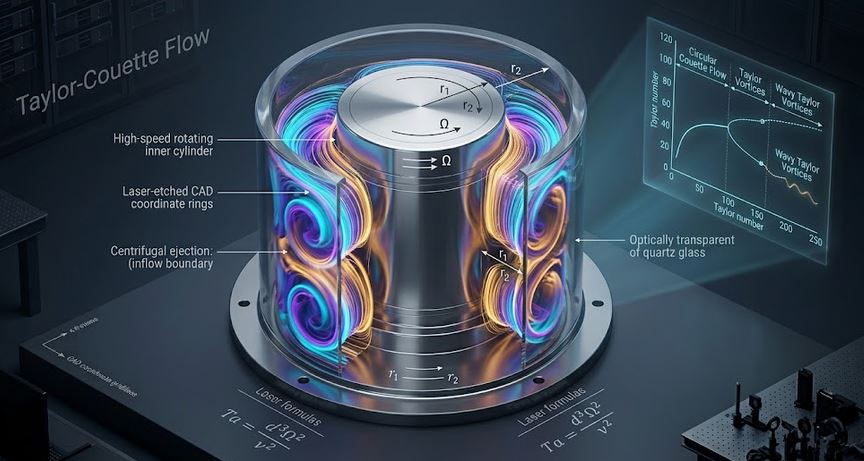
🌀 Concentric Rotating Cylinders & Toroidal Taylor Vortex Cells
Real-time visual simulation of centrifugal instability vortex pairs forming between inner rotor & outer stator📝 Configuration & Presets
Taylor-Couette Stability Formulations:
• Taylor Number: Ta = [ 2 Ω₁² R₁ d³ ] / [ ν² (1 + η) ]
• Critical Stability: Tac ≈ 1708 / (1 − 0.652 d/R₁)
• Critical Speed: N1,c = (60/2π) · √[ Tac ν² (1+η) / (2 R₁ d³) ]
• Vortex Pair Wavelength: λ ≈ 2 d [mm]
• Taylor Number: Ta = [ 2 Ω₁² R₁ d³ ] / [ ν² (1 + η) ]
• Critical Stability: Tac ≈ 1708 / (1 − 0.652 d/R₁)
• Critical Speed: N1,c = (60/2π) · √[ Tac ν² (1+η) / (2 R₁ d³) ]
• Vortex Pair Wavelength: λ ≈ 2 d [mm]
📊 Hydrodynamic Stability Results
Configure inputs and click Compute to view results.
📘 Calculation Methodology & Taylor Stability Standards
Centrifugal Instability Mechanism
When the inner cylinder rotates faster than the outer wall, centrifugal forces destabilize the fluid element, giving birth to toroidal Taylor vortices when $Ta > Ta_c \approx 1708$:
Ta = [ 2 Ω₁² R₁ d³ ] / [ ν² (1 + η) ]
Toroidal Vortex Cells Structure
Each pair of toroidal vortex cells occupies an axial wavelength $\lambda \approx 2d$, rotating in alternating counter-clockwise and clockwise directions.
Key Engineering Assumptions
- Isothermal Newtonian fluid with constant kinematic viscosity.
- Narrow to medium annular gap ($0.5 \le \eta \le 0.98$).
- Negligible end-wall Ekman layer perturbations.