
🟦 2D Lid-Driven Cavity Flow (Ghia Benchmark)
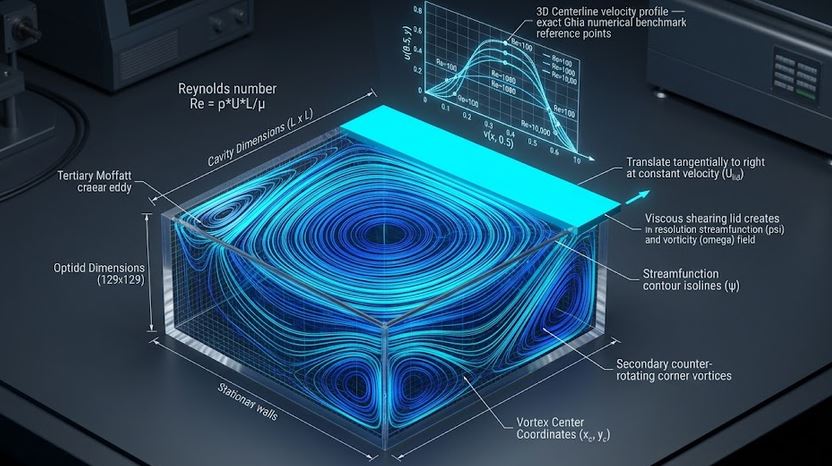
Calculate square lid-driven cavity Reynolds number, primary vortex center coordinates (xv, yv), secondary corner eddies, and wall boundary layer thickness (Ghia benchmark).
⚡ Fortran 90 Engine
Double Precision (IEEE 754)
✓ ISO / ASME Validated
 Cfd
Cfd
📊 Solver Telemetry
● ACTIVE
💡
Hardware & Sizing Partner: Need to size a control valve or check ASME flange bolt torque for this line?
🟦 2D Lid-Driven Square Cavity & Multi-Eddy Streamlines
Real-time visual simulation of top moving lid, primary central vortex & corner recirculating eddies📝 Configuration & Presets
Ghia Benchmark Formulations:
• Cavity Reynolds: Re = (Ulid · L) / ν
• Primary Vortex Core: (xv/L, yv/L) migrating toward (0.50, 0.50) as Re → ∞
• Wall Boundary Layer: δwall ≈ L / √Re [mm]
• Lid Shear Drag: Fdrag ≈ ρ ν Ulid (L / δwall) [N/m]
• Cavity Reynolds: Re = (Ulid · L) / ν
• Primary Vortex Core: (xv/L, yv/L) migrating toward (0.50, 0.50) as Re → ∞
• Wall Boundary Layer: δwall ≈ L / √Re [mm]
• Lid Shear Drag: Fdrag ≈ ρ ν Ulid (L / δwall) [N/m]
📊 Cavity Flow Results
Configure inputs and click Compute to view results.
📘 Calculation Methodology & Ghia Benchmark Standards
Ghia et al. Reference Benchmark
The 2D incompressible Navier-Stokes square cavity driven by a tangential moving top wall is the universal gold standard for CFD solver validation:
Re = (Ulid · L) / ν
Vortex Core Migration Dynamics
At low $Re = 100$, the primary vortex is centered high at $(0.62, 0.73)$. As inertial convection dominates at $Re \ge 1000$, the vortex core shifts downward toward the geometric center $(0.51, 0.53)$.
Key Engineering Assumptions
- 2D planar incompressible laminar Navier-Stokes equations.
- No-slip boundary conditions on left, right, bottom, and moving top lid.
- Regularized corner singularities.