
🌪️ von Kármán Vortex Shedding (Strouhal Frequency)
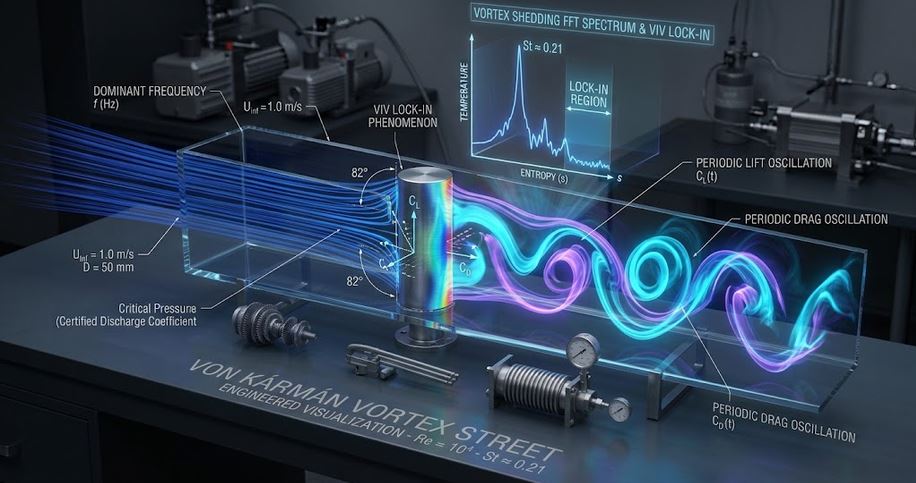
Determine cross-flow cylinder vortex shedding frequency (fs in Hz), Strouhal number (St), fluctuating lift force, and vortex street dimensions (h/a = 0.281).
⚡ Fortran 90 Engine
Double Precision (IEEE 754)
✓ ISO / ASME Validated
 Cfd
Cfd
📊 Solver Telemetry
● ACTIVE
🌪️ Cross-Flow Cylinder & von Kármán Vortex Street Wake
Real-time visual simulation of periodic alternating clockwise and counter-clockwise vortex core shedding📝 Configuration & Presets
🏭 Industrial Stack (1.2m)
🌊 Subsea Pipeline (400mm)
⚡ Power Cable Aeolian Humming
🚰 Heat Exchanger Tube (20mm)
Strouhal Vortex Formulations:
• Strouhal Number: St = (fs · D) / U∞ ≈ 0.198 (1 − 19.7/Re)
• Shedding Frequency: fs = (St · U∞) / D [Hz]
• Fluctuating Lift: F′L,rms = ½ ρ U∞² D · CL,rms [N/m]
• Stable Spacing Ratio: h / a ≈ 0.281
• Strouhal Number: St = (fs · D) / U∞ ≈ 0.198 (1 − 19.7/Re)
• Shedding Frequency: fs = (St · U∞) / D [Hz]
• Fluctuating Lift: F′L,rms = ½ ρ U∞² D · CL,rms [N/m]
• Stable Spacing Ratio: h / a ≈ 0.281
📊 Vortex Shedding Results
Configure inputs and click Compute to view results.
📘 Calculation Methodology & Strouhal Standards
Strouhal Shedding Law
Above $Re_D \approx 47$, laminar boundary layer separation becomes unstable, shedding regular alternate vortex pairs into the wake with non-dimensional frequency $St$:
fs = (St · U∞) / D
Vortex-Induced Vibration (VIV)
Periodic pressure imbalance from alternating vortex shedding exerts fluctuating cross-flow lift forces that can cause destructive resonance in chimneys, marine risers, and tubes.
Key Engineering Assumptions
- Uniform steady 2D cross-flow past smooth circular cylinder.
- Subcritical turbulent boundary layer separation ($Re_D < 2\times 10^5$).
- von Kármán stability spacing ratio $h/a \approx 0.281$.