🔥 Compressible Rayleigh Flow (Heat Addition)
Evaluate 1D compressible flow with heat addition or combustion, computing exit Mach (M2), thermal choking limit (q_max), stagnation pressure loss, and entropy generation.
⚡ Fortran 90 Engine
Double Precision (IEEE 754)
✓ ISO / ASME Validated
 Cfd
Cfd
📊 Solver Telemetry
● ACTIVE
💡
Hardware & Sizing Partner: Need to size a control valve or check ASME flange bolt torque for this line?
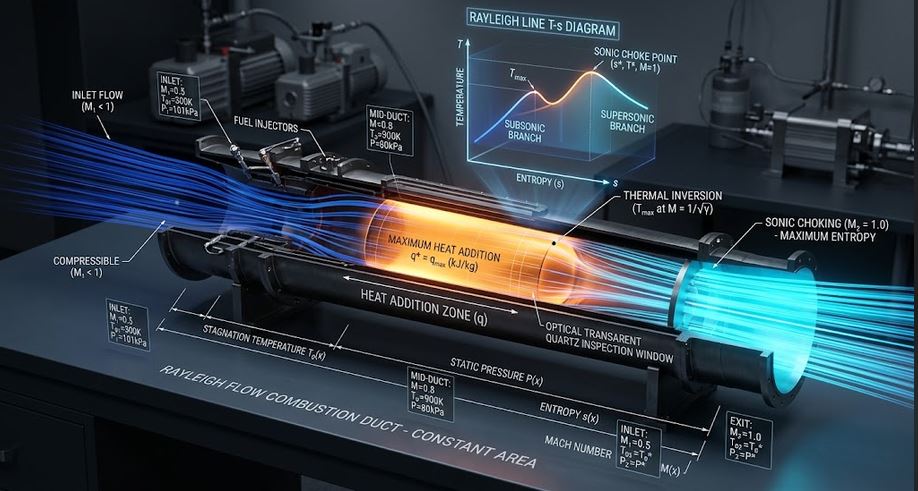
🔥 Combustor Duct Thermal Expansion & Thermal Choking (M = 1.0)
Real-time visual simulation of flame heat zone, thermal acceleration & Rayleigh entropy increase📝 Configuration & Presets
Rayleigh Flow Formulations:
• Stagnation Temp Ratio: T₀/T₀* = 2(γ+1)M² (1 + ½(γ−1)M²) / (1 + γM²)²
• Max Heat Addition: qmax = cp (T₀* − T₀₁) [kJ/kg]
• Heat addition accelerates subsonic flow toward M=1 and decelerates supersonic flow.
• Total Pressure Loss: ΔP₀ is unavoidable during heat addition at high speed.
• Stagnation Temp Ratio: T₀/T₀* = 2(γ+1)M² (1 + ½(γ−1)M²) / (1 + γM²)²
• Max Heat Addition: qmax = cp (T₀* − T₀₁) [kJ/kg]
• Heat addition accelerates subsonic flow toward M=1 and decelerates supersonic flow.
• Total Pressure Loss: ΔP₀ is unavoidable during heat addition at high speed.
📊 Rayleigh Flow Results
Configure inputs and click Compute to view results.
📘 Calculation Methodology & Rayleigh Flow Standards
Thermal Choking Limit
Adding heat to a subsonic compressible flow increases Mach number and entropy up to the sonic point $M=1$. Exceeding $q_{max}$ causes thermal choking:
qmax = cp (T₀* − T₀₁)
Combustion Total Pressure Loss
Fundamental momentum conservation dictates that adding thermal energy to a high-speed gas creates an unavoidable fundamental total pressure drop $\Delta P_0$.
Key Engineering Assumptions
- 1D steady frictionless flow in constant cross-sectional area duct.
- Uniform thermal energy addition across the stream.
- Ideal gas with constant average $c_p$ and $\gamma$.