🔥 Hypersonic Aerodynamic Heating (Sutton-Graves)
Calculate hypersonic stagnation convective heat flux (kW/m²), radiative equilibrium wall temperature (Trad), and stagnation enthalpy using Sutton-Graves and US 1976 atmosphere.
⚡ Fortran 90 Engine
Double Precision (IEEE 754)
✓ ISO / ASME Validated
 Cfd
Cfd
📊 Solver Telemetry
● ACTIVE
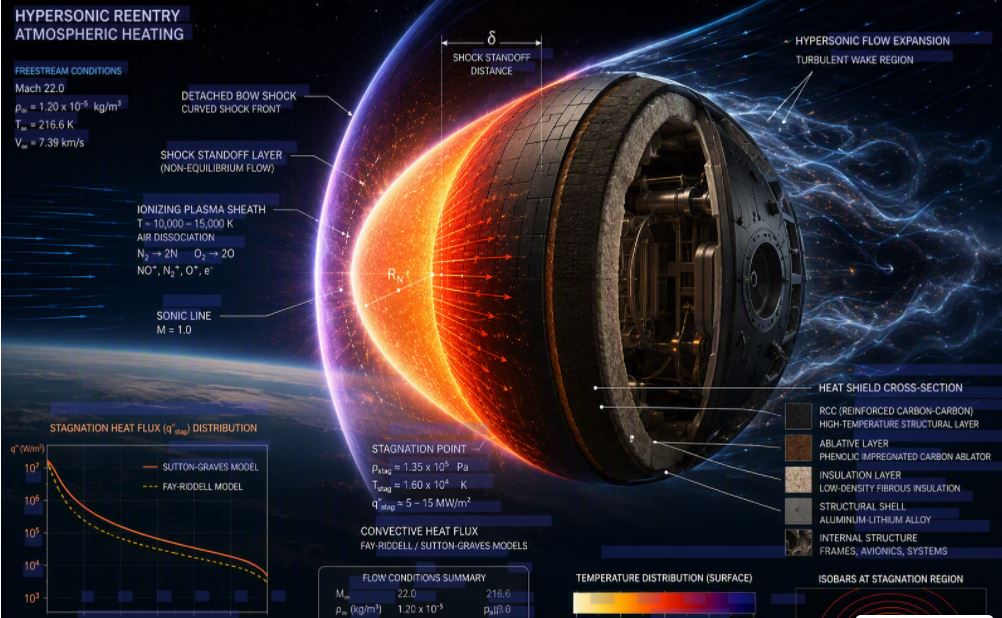
🔥 Hypersonic Bow Shock Wave & Stagnation Point Plasma Sheath
Real-time visual simulation of detached bow shock, stagnation plasma layer & radiative thermal glow📝 Configuration & Presets
🛰️ LEO Capsule (7.5 km/s)
🚀 Wave-Rider Glide (Mach 11)
🌕 Lunar Return (11 km/s)
✈️ Scramjet Cruise (Mach 7)
Sutton-Graves Heating Formulations:
• Stagnation Flux: q̇₀ = kSG · √(ρ∞ / Rn) · V∞³ [W/m²]
• Radiative Wall Temp: Trad = ( q̇₀ / (ε · σ) )1/4 [K]
• Total Enthalpy: h₀ = cp T∞ + ½ V∞² [MJ/kg]
• Post-Shock Pressure: P₀₂ ≈ 0.92 · ρ∞ · V∞² [kPa]
• Stagnation Flux: q̇₀ = kSG · √(ρ∞ / Rn) · V∞³ [W/m²]
• Radiative Wall Temp: Trad = ( q̇₀ / (ε · σ) )1/4 [K]
• Total Enthalpy: h₀ = cp T∞ + ½ V∞² [MJ/kg]
• Post-Shock Pressure: P₀₂ ≈ 0.92 · ρ∞ · V∞² [kPa]
📊 Aerodynamic Heating Results
Configure inputs and click Compute to view results.
📘 Calculation Methodology & Hypersonic Aerothermodynamic Standards
Sutton-Graves Convective Model
Derived from boundary layer boundary solutions with high-temperature gas dissociation equilibrium. Convective heat flux scales inversely with the square root of nose radius $R_n$:
q̇₀ = 1.7415 × 10⁻⁴ · √(ρ∞ / Rn) · V∞³
Radiative Surface Equilibrium
Assuming negligible interior conduction into the Thermal Protection System (TPS), wall temperature reaches radiative balance: $q_{conv} = \epsilon \sigma T_{rad}^4$.
Key Engineering Assumptions
- 1976 US Standard Atmosphere piecewise thermodynamic equations.
- Axisymmetric spherical / cylindrical blunt stagnation point.
- Equilibrium laminar hypersonic boundary layer.